
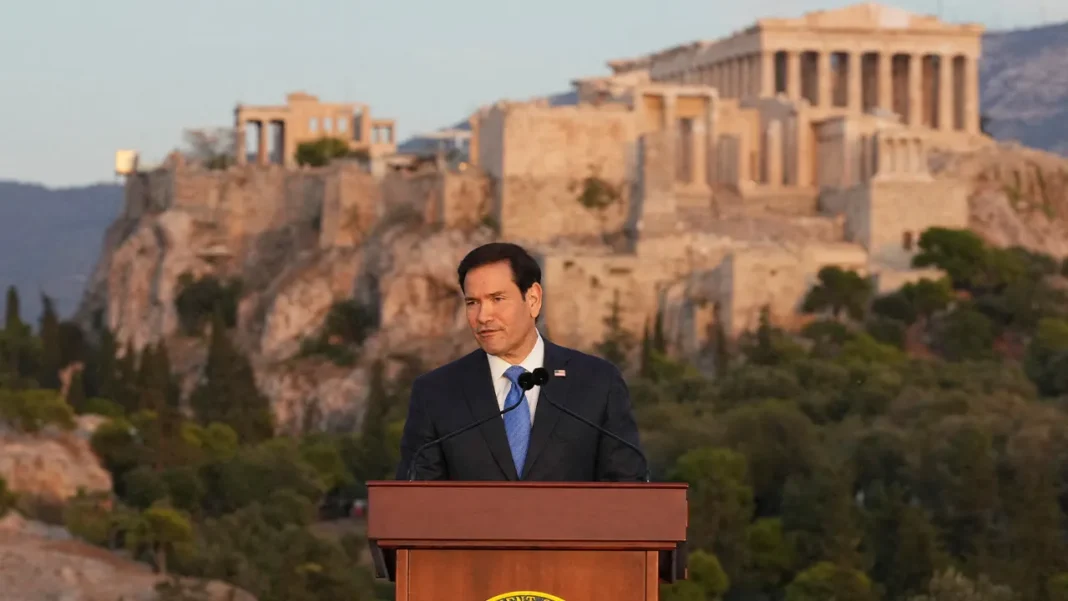
Secretary of State Marco Rubio toured the Arctic, visiting Reykjavik, Greenland and Iceland to block China’s growing influence and secure U.S. interests. He met Iceland’s foreign minister, saying the location remains a critical outpost for monitoring clandestine behavior and deterring adversaries, and noted any military expansion would require Icelandic consent.
Rubio’s Arctic Diplomatic Sweep
The visit follows a landmark deal with Denmark that gives the United States authority to prevent Chinese presence in Greenland, screen foreign investment, and control missile‑defense and undersea access. The agreement preserves Greenland’s sovereignty, remains in force perpetually, and fills gaps left by the 1951 treaty.
Greenland Deal Grants Permanent U.S. Military Access
The pact lets the United States block non‑NATO military and commercial activity in Greenland’s airspace and territorial waters, ensuring unrestricted undersea passage. It also guarantees U.S. access to overflight and missile‑defense capabilities across Greenland’s territorial waters.
Critics who called the negotiations “much ado about nothing” ignore the strategic value of new Arctic shipping lanes that will shape global trade for decades. These lanes will reshape global shipping and military posturing for years to come.
The deal arrives as NATO faces renewed pressure from Russian aggression, underscoring the need for a strong alliance. A robust alliance is essential to counter emerging threats in the region.
China’s Push for Sea‑Lane Dominance
China aims to replace the United States as the leading global superpower by controlling critical sea lanes, giving it leverage over markets, resources and power projection. Its strategy hinges on dominating the Arctic routes that will become increasingly navigable as ice melts.
Rubio’s diplomatic push, alongside a separate agreement with Panama that ended a Chinese‑run container terminal contract, signals a coordinated effort to curb Beijing’s reach. The move reflects a broader U.S. strategy to protect vital maritime corridors.
While Trump’s threats to seize Greenland by force sparked NATO alarm and market volatility, effective diplomacy under Rubio delivered tangible gains. Foresight and negotiation, not brinkmanship, secured the agreement.
The administration credits Rubio’s foresight and negotiation skills for securing permanent U.S. military rights and checking China’s Arctic ambitions, a win for U.S. security and NATO cohesion. This outcome demonstrates the value of strategic diplomacy over coercive rhetoric.

