
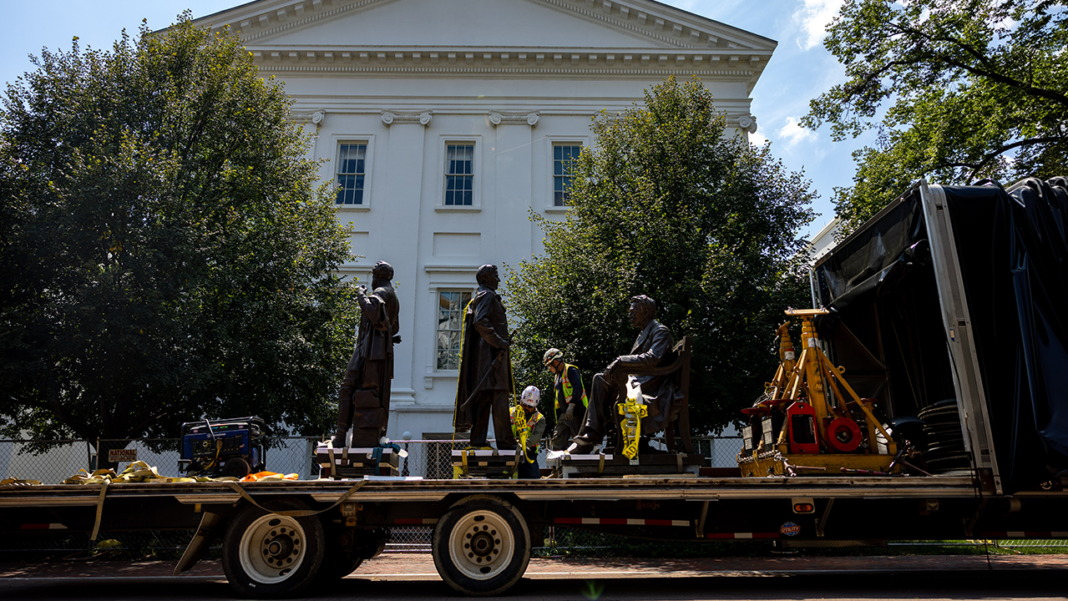
Confederate statues were taken down from Richmond’s Capitol Square on Friday, marking the latest chapter in the nation’s ongoing battle over historical monuments.
Statues Removed from Capitol Square
The removals included the statue of Dr. Hunter Holmes McGuire, a Confederate surgeon who helped shape the Geneva Convention’s protections for medical personnel, as well as the monument to General Thomas “Stonewall” Jackson and the figure of William “Extra Billy” Smith.
The statues were loaded onto a truck and removed under a process overseen by Democratic state Senator Mike Jones, who argued that the imagery reinforced a legacy of racial segregation.
Critics warned that erasing these figures disregards their contributions to humanitarian law and the broader narrative of American history.
McGuire’s Humanitarian Contributions
McGuire served as a Confederate surgeon throughout the Civil War, treating thousands of soldiers and pioneering a policy that treated battlefield medics as non‑combatants.
In May 1862, after the First Battle of Winchester, he persuaded General Jackson to release six captured Union doctors, establishing the Winchester Accord, a precedent that later informed the Geneva Convention’s treatment of medical personnel.
The accord was formally adopted into the 1906 Geneva Convention, granting protection to medics in armed conflict — a standard still in effect today.
Despite these achievements, his statue was toppled on Friday, joining a wave of monument removals across the South.
Political and Public Reaction
Senator Mike Jones said the decision was driven by personal recollections of segregated signage in his mother’s scrapbook, describing the presence of the statue as “wrong.”
Opponents argue that the removal reflects a broader progressive agenda to rewrite history rather than address present‑day inequities.
The Shenandoah Valley Battlefields Foundation announced that the statues will be relocated to historic battlefields, asserting that preserving them in context will serve future generations.
A foundation spokesperson emphasized that “preservation is more about the future than the past,” and that shared history can unite the nation.
Analysts note that the episode underscores continuing tension between calls for racial reckoning and efforts to honor individuals who contributed to humanitarian standards.

