
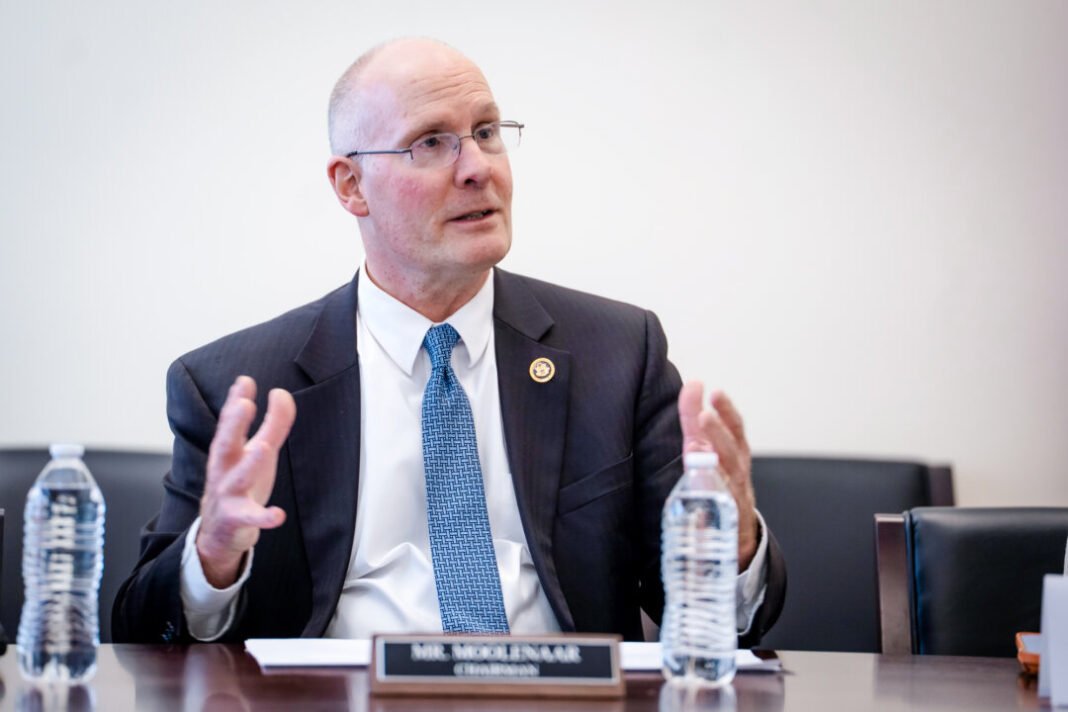
The House Select Committee on the Chinese Communist Party released more than 700 pages of previously sealed federal investigative records on Oct. 13, exposing undisclosed ties between U.S. university researchers and Chinese institutions.
Committee Calls for SIRA Act
Chairman John Moolenaar (R-Mich.) said Congress must pass the Securing Innovation and Research from Adversaries (SIRA) Act to create uniform safeguards and prevent taxpayer dollars from funding collaborations with entities flagged as national security risks.
The committee’s report, released Oct. 13, contains over 700 pages of nonpublic Office of Inspector General records that detail undisclosed affiliations, foreign compensation and research ties between U.S. scholars and Chinese institutions.
Former University Provost’s Chinese Appointments
Investigators uncovered that Enrique Lavernia, former executive vice chancellor and provost of the University of California‑Irvine, maintained undisclosed links to Wuhan University of Technology and participated in Beijing’s Thousand Talents recruitment program.
A 2020 NSF probe found Lavernia received a Chinese Government Friendship Award in 2017 and a contract offering $50,000 per month, research‑team funding and laboratory support, though the document does not confirm every payment was actually delivered.
Federal records show Lavernia omitted his Chinese affiliations and compensation from required disclosures and from a Department of Energy security‑clearance reinvestigation, despite receiving roughly $5.2 million in federal research awards since fiscal year 2012.
NSF imposed a government‑wide suspension on Lavernia in July 2020, temporarily barring him from federal grants; the records do not indicate when or how that suspension was resolved.
Lavernia joined Texas A&M in 2023 and was named a university distinguished professor in March 2026, with university materials citing ongoing NSF and Energy Department support.
Stanford Research Awards Under Scrutiny
An October 2022 NSF investigation identified at least 26 Stanford University awards linked to researchers who participated in foreign‑funded projects without disclosure, involving more than $12.8 million in claimed costs.
Investigators recommended suspending 14 awards due to disclosure deficiencies, though the documents do not confirm that all suspensions were enacted or that the full amount was improperly spent.
Stanford senior director of pre‑award operations Michiko Pane said her office did not independently verify the information researchers submitted, stressing that researchers bear responsibility for accurate funding disclosures.
NSF also found that professor Richard Zare held a Thousand Talents Program appointment requiring three months of work annually at a foreign university, a fact Stanford knew since May 2019 but did not report to NSF, prompting a recommendation to suspend his $464,000 award.
Congress Seeks Stronger Research Safeguards
The committee’s report urges stronger monitoring of federal research grants, government‑wide security standards and broader use of suspensions and debarments based on investigative findings.
The proposed SIRA Act would restrict federally funded collaborations with entities on the War Department’s Section 1260H and Section 1286 lists—identified as Chinese military companies and individuals or institutions posing national security concerns—while allowing limited waivers.
NSF spokesman Mike England said the agency already requires disclosure of foreign affiliations, prohibits participation in malign talent‑recruitment programs and mandates research‑security training, and is developing a policy to bar institutions from using NSF funds to collaborate with restricted‑entity list members and to prevent senior personnel from holding concurrent appointments with those entities.
England emphasized that the safeguards target bad‑faith conduct such as undisclosed foreign funding, IP theft or talent‑program participation, not international collaboration itself, which NSF considers essential to scientific progress.

