
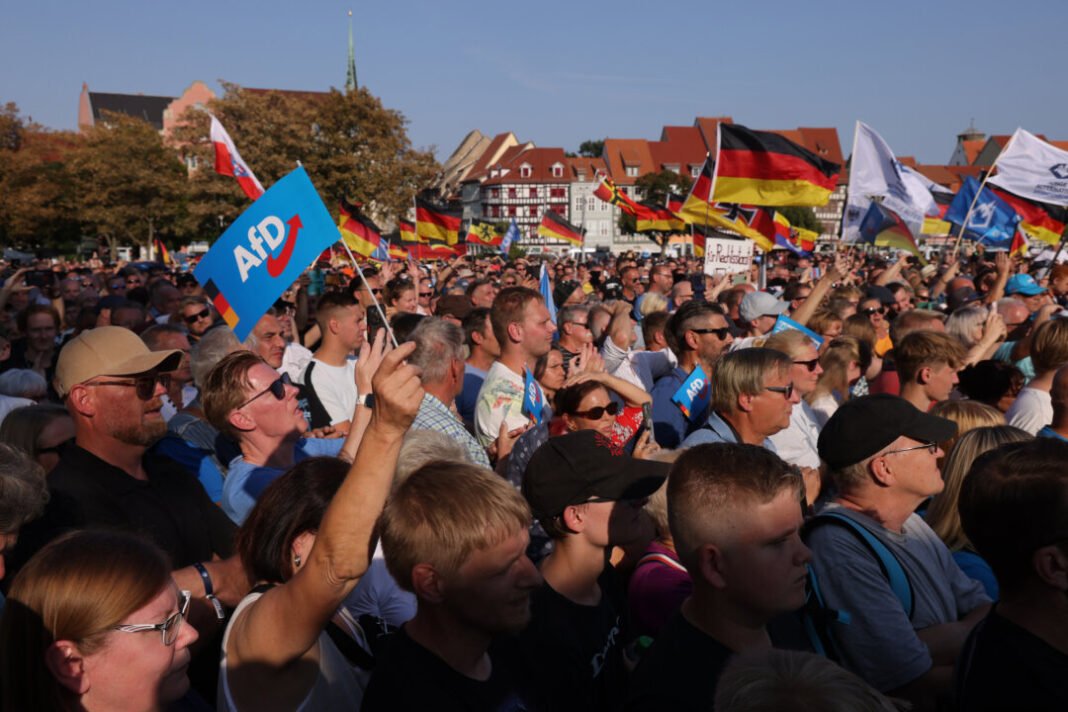
The anti‑mass‑migration Alternative for Germany (AfD) captured 44% of the vote in Saxony‑Anhalt, a result that upends Germany’s political landscape and fuels a broader European backlash against open borders.
AfD Surge in Saxony‑Anhalt Triggers Europe‑Wide Immigration Debate
The Christian Democratic Union (CDU) saw its vote halve compared with the previous election, raising doubts about whether any coalition can accommodate the AfD without violating its own pledge to exclude the party from government.
Podcast host Jack Fowler asked Victor Davis Hanson for his take, and Hanson framed the result as evidence that European voters are “done” with elite policies on immigration, energy costs and national sovereignty.
Hanson cited the United States, arguing that repeated legal attacks on Donald Trump only boosted his popularity, and said similar dynamics are driving anti‑establishment sentiment across Europe.
He warned that open borders, illegal immigration and costly green energy are eroding European competitiveness and that the AfD is pushing for a withdrawal from the EU and, potentially, NATO.
Hanson predicted further upheaval, naming France’s Emmanuel Macron, Britain’s Labour left, Spain’s Pedro Sánchez and Italy’s Giorgia Meloni as figures whose political fortunes may collapse under the same pressure.
He also linked the rise of the AfD to a broader cultural shift, claiming that contemporary immigration aims to create parallel societies rather than integrate newcomers into existing European norms.
The discussion turned to race, with Hanson recounting personal experiences of prejudice in mixed‑ethnicity schools and arguing that all ethnic groups, not just whites, can exhibit tribal chauvinism.
He asserted that the black community in Los Angeles, for example, has turned against Hispanic residents, illustrating what he sees as reciprocal hostility among demographic groups.
Fowler challenged the notion that only whites can be racist, and Hanson replied that rejecting the European Enlightenment leaves any culture vulnerable to internal prejudice.
Both men concluded that the AfD’s surge signals a decisive moment for Europe, one that could reshape the continent’s immigration, security and economic policies.

