
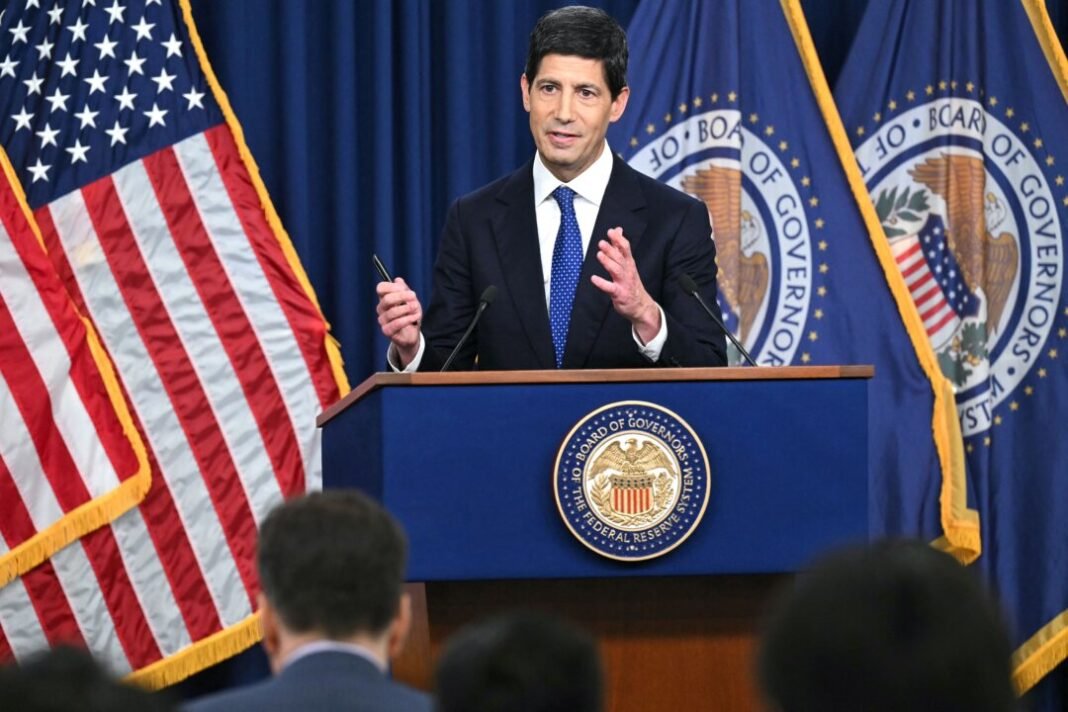
The Federal Reserve raised rates during an oil shock, but falling commodities and collapsing inflation expectations now signal disinflation, not overheating. This divergence shows the Fed’s policy may be misaligned with reality.
Fed Tightening Amid Oil Shock
FOMC minutes show most participants favor further hikes. Two members dissented, urging an immediate increase. Governor Christopher Waller urged a half‑point move in December to “shock people.”
Market Signals Indicate Disinflation
Brent crude fell about 20% in November, and gasoline futures dropped roughly 20%. Heating oil fell 21%, copper 16%, silver 28%, wheat 11% and sugar 17%, while the CRB index slipped over 10%. Retail gasoline fell to $3.65, a 15% decline.
One‑year USD swaps fell below 2%, and two‑year swaps are near 2.1%. The 30‑year inflation swap held steady at 2.3‑2.5% despite the Iran‑related shock.
Core PCE stayed at 3.0% for three quarters and rose barely to 3.1% in September. This contradicts hawkish forecasts of a second‑round surge.
Philadelphia Fed projects 2026 core PCE at 3.3% and 2027 at 2.4%. The Fed’s own outlook left 2026 unchanged and lifted 2027 rates to 4.1%, tightening without inflation change.
Policy Risks and Outlook
J.P. Morgan’s NLP Hawk‑Dove score now exceeds 30, the highest level since 2022. Central banks are tightening even as commodity momentum fades.
Hawks cite three months of 0.3% core CPI gains. Yet pass‑through from energy to core goods is negligible as transport prices fall.
Monetary policy lags span 12‑18 months. Hiking now will impose tighter conditions after the shock fades, risking a private‑sector contraction.
Inflation remains a monetary phenomenon; oil spikes without money creation merely shift spending. Raising rates is akin to chemotherapy for a broken leg.
Rate hikes have made credit costlier for households and small businesses. They have also inflated federal interest expense, prompting Citigroup to warn rates are unsustainably high.
Citi expects a December hike, a hold, then cuts in 2027. This follows the classic pattern of tightening into a peak and easing into a slump.
A December hike would be stubbornness masquerading as credibility. The Fed’s data‑dependent claim rings hollow.
Job market and core inflation show no need for further hikes. The Taylor‑rule rate estimate falls below current levels, supporting a cut.
Central banks missed 2021 inflation by ignoring monetary excess. Now they repeat the error by treating a supply shock as a monetary problem, risking another policy failure.
Engineering a market sell‑off with unwarranted hikes reflects irresponsibility, not independence. Such moves undermine the Fed’s credibility.

