
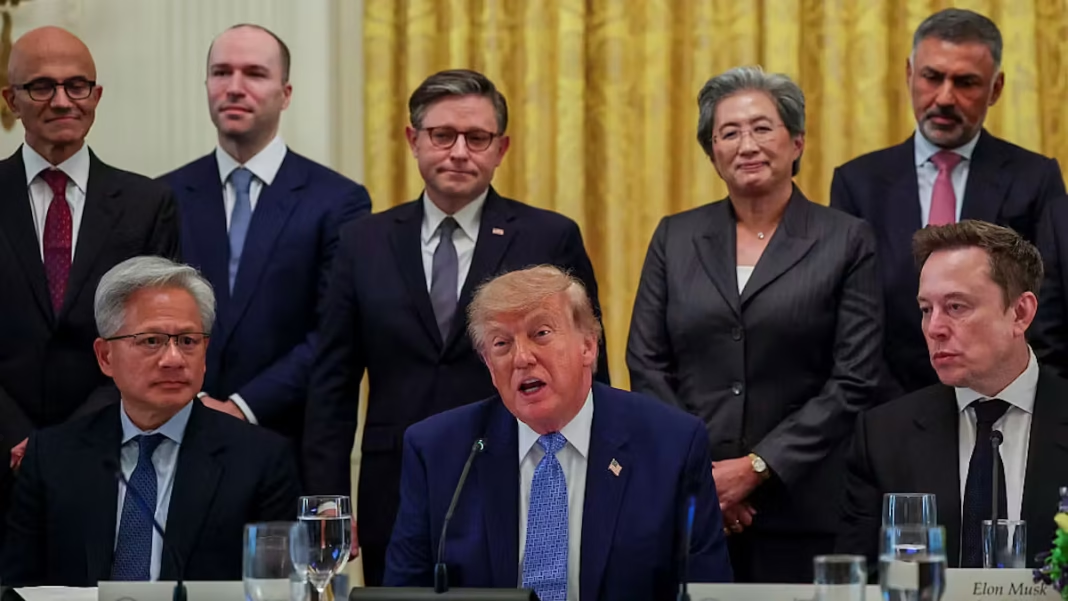
President Donald Trump announced Tuesday that he is renaming artificial intelligence to super intelligence, saying the new label reflects accuracy and power.
“We’re changing the name to super intelligence and everybody likes it,” Trump declared, adding that the rename stops the misleading term “artificial.” He formalized the shift with an executive order governing the federal government.
White House Accord and Industry Commitments
The White House Accord on Super Intelligence, signed by industry leaders and House Speaker Mike Johnson, outlines voluntary safety pledges Trump calls morally binding.
AI CEOs, including Anthropic’s Dario Amodei, have urged a deliberate slowdown to let safety research keep pace, with Amodei assigning a 25% risk that AI could cause catastrophic harm.
Public Concern and Economic Claims
A CNN poll shows 90% of Americans fear AI could surpass human intelligence, while 70% say the government isn’t regulating it enough.
Trump insists the technology will fuel economic growth and help the nation outrun its mounting debt, pledging not to stifle innovation.
National Security and Global Competition
Trump frames AI leadership as essential for U.S. security amid China’s rapid advancement, a point underscored by former AI adviser David Sacks, who warned that losing the AI race would reshape global power unfavorably.
Chinese surveys indicate 69% see AI benefits as outweighing risks and 72% trust the technology, compared with 32% of Americans; Trump and President Xi Jinping agreed last week to establish an AI safety channel between the two nations.
Industry Pushback and Political Reactions
Amodei’s call for a slowdown met agreement from OpenAI’s Sam Altman and Elon Musk, but Trump dismissed the concerns on Truth Social, asserting a “strong and smart” president is the only needed guardrail.
The Pentagon recently labeled Anthropic a supply chain risk after the company refused to allow its technology for mass surveillance or fully autonomous weapons, a stance reinforced by a dinner between Amodei and Trump two nights before the signing.
Palantir CEO Alex Karp, an outspoken AI advocate, argues that any slowdown would be reckless while China remains a competitive threat.

