
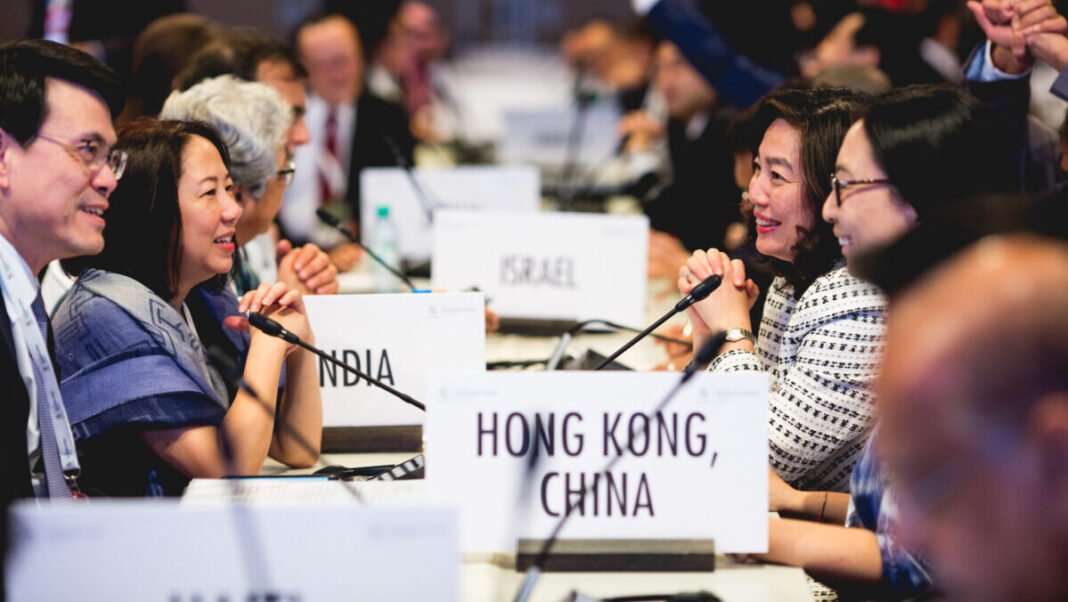
China’s accession to the World Trade Organization on Dec. 11, 2001 has been cited as a catalyst for the West’s economic decline. The event occurred three months after the September 11 attacks, marking a turning point in global trade.
Trading Places
At the time, China’s economy was smaller than those of the United Kingdom, Japan, Germany and France, according to IMF data. Today it dwarfs those four nations combined, with GDP more than ten times its 2001 level, the World Bank reports.
Beijing has employed state subsidies, punitive taxes on foreign firms and forced technology transfers to boost its manufacturers, according to a 2022 Peterson Institute analysis. These tactics have given Chinese firms a competitive edge in global markets.
Lower wages allowed Chinese producers to flood Western markets, eroding domestic manufacturing in the United States and Europe, a trend documented by the U.S. Census Bureau. The resulting job losses have sparked political backlash in many Western countries.
The resulting decline in Western factories was foreseeable, analysts say. They warned that unchecked trade imbalances would undermine industrial capacity.
War On Terror Or War In Error?
The Clinton administration promoted China’s WTO entry as a path to democratic liberalization, a claim reflected in a 2000 speech before Johns Hopkins University, where Clinton asserted that economic freedom would unleash the Chinese people’s initiative. The rhetoric promised a swift cultural transformation that never materialized.
He promised that trade would bring democratic values, quoting Justice Earl Warren that liberty is the most contagious force, a statement recorded in the speech transcript. The claim that liberty would spread like a contagion proved overly optimistic.
Twenty‑six years later, the Chinese politburo still has zero women, matching the Taliban Council of Ministers, according to official party rosters. The stagnation of women’s representation underscores the limits of economic liberalization on gender equality.
Former Secretary of State Madeleine Albright argued that WTO membership would empower Chinese women, a prediction that has not materialized, as noted by scholars of gender studies. Albright’s optimism mirrored the broader belief that trade would automatically produce democratic reforms.
President George W. Bush echoed similar optimism in a 2003 speech, claiming that WTO‑enabled economic reform would spur democracy in the Middle East, according to the White House transcript. Bush’s remarks linked economic openness to political change, a connection that scholars now deem simplistic.
He suggested that economic freedom would inevitably lead to social and political liberty, a view criticized by political scientists for ignoring cultural differences. The theory ignored entrenched cultural and institutional differences.
In practice, China has not become more like the West since 2001; it has leveraged the illusion of convergence to pursue its own geopolitical agenda, a conclusion drawn by the Carnegie Endowment for International Peace. The outcome shows that external reforms cannot force internal political evolution.
Analysts agree that the West’s initial faith in China’s transformation was misplaced, and that the country’s rise reflects strategic exploitation rather than inevitable convergence.

