
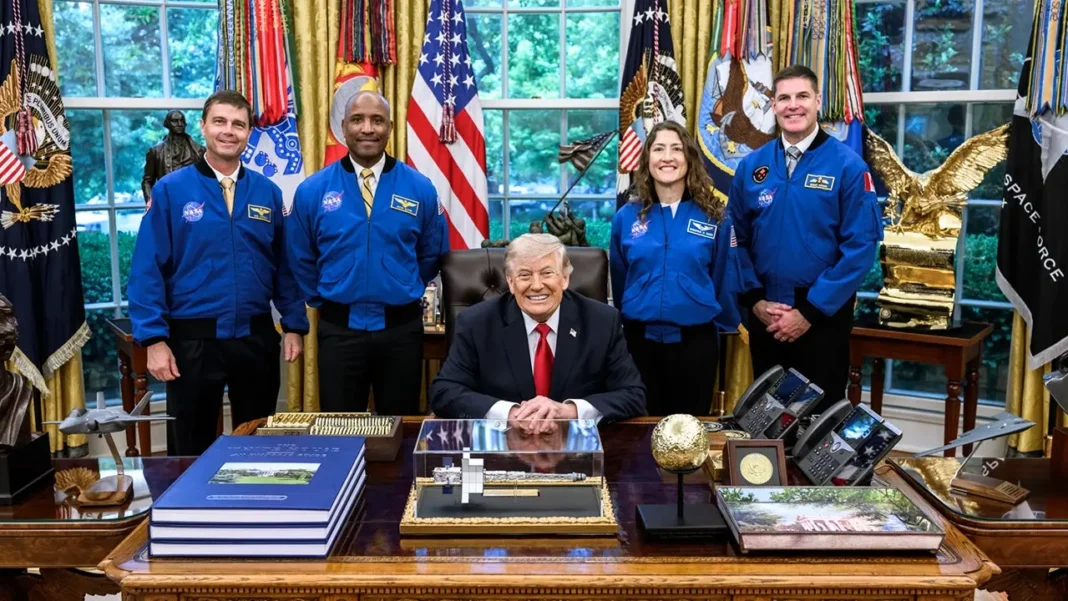
Artemis II has completed the farthest crewed flight from Earth in more than half a century, looping around the Moon and breaking the Apollo 13 distance record. The crew traveled 252,756 miles at their peak, surpassing the 1970 Apollo 13 mark.
Historic Lunar Flyby and Distance Record
NASA launched the Space Launch System on April 1 from Kennedy Space Center, generating 8.8 million pounds of thrust. The Orion spacecraft carried Commander Reid Wiseman, Mission Specialist Christina Koch, Pilot Victor Glover and Canadian Space Agency astronaut Jeremy Hansen.
At its closest approach, Orion passed within 4,067 miles of the lunar surface before returning to Earth on April 10, splashing down in the Pacific after a 695,081‑mile journey lasting nearly ten days.
The crew logged more than 7,000 images, including earthrise, lunar craters and a solar eclipse viewed from Orion, and reported meteoroid impact flashes on the Moon’s night side.
Astronauts to Receive Congressional Space Medal of Honor
President Donald Trump will present the Congressional Space Medal of Honor to the four Artemis II astronauts at a ceremony on August 28 at NASA’s Johnson Space Center in Houston.
The medal, established by Congress in 1969, recognizes exceptionally meritorious contributions to the nation and mankind; only 30 astronauts have received it, including Neil Armstrong, John Glenn, Alan Shepard and Apollo 13 commander Jim Lovell.
If the four are honored, the total will rise to 34 recipients, underscoring the historic nature of the mission.
Mission Objectives and Future Plans
During Artemis II, the crew tested Orion’s life‑support systems, manually piloted the spacecraft and gathered data to prepare for deep‑space operations.
NASA plans to evaluate commercial lunar lander operations in low Earth orbit during Artemis III in 2027, followed by the first crewed lunar landing on Artemis IV in 2028.
The program aims to establish a permanent lunar presence and lay the groundwork for crewed missions to Mars.
Political Context and Statements
President Trump has framed Artemis II as a cornerstone of his administration’s space agenda, pledging a lunar base by 2028 and asserting the United States will beat China to the Moon.
NASA Administrator Jared Isaacman said the crew accepted significant risk while testing systems intended for future deep‑space travel, noting the mission captivated the world and inspired a new generation.
Isaacman added that, under Trump’s leadership, America will return to the Moon to build a base and stay, with Artemis III leading the campaign and Artemis IV executing the 2028 landing.

