
Dead Sea Scrolls Near End of Run
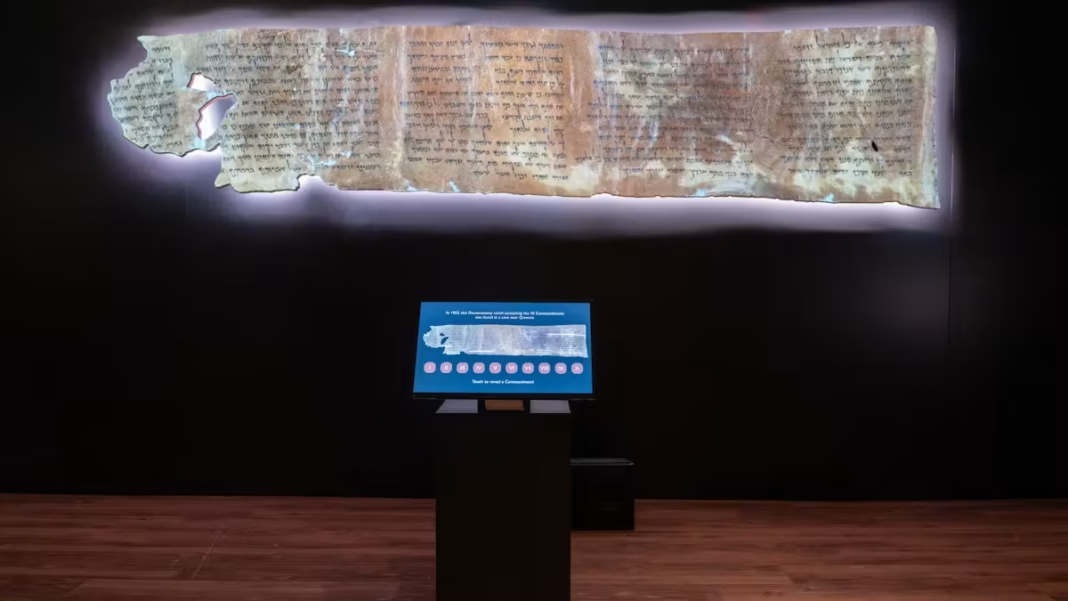
The oldest surviving biblical manuscripts are on display for a final few weeks at the Museum of the Bible in Washington. The Dead Sea Scrolls exhibition closes September 7, ending its last rotation on the fifth floor.
Recovered from the Qumran caves, the fragments are among the twentieth century’s most important archaeological finds, providing a direct window into the Hebrew Scriptures and the Jewish world of the Second Temple period.
Dr. Carlos Campo, President and CEO of the Museum of the Bible, said the collection is divided into three parts: roughly a third are biblical texts, a third detail the community’s rules, and the remainder cover ancient practice.
The Qumran community, known as the Essenes, withdrew to the Dead Sea, studied the texts carefully, and followed strict purification rules. Scholars believe they settled there to prepare for the coming of the Messiah.
Campo emphasized that the Messiah was central to Jewish expectation, not just Christian doctrine. “The scrolls repeatedly stress the Messiah,” he said, noting the focus predates the New Testament.
The exhibition shows Judaism was far more diverse than the Pharisees and Sadducees familiar from the New Testament. “The Qumran group was a distinct sect, outside those two major movements,” Campo added.
One displayed fragment comes from Isaiah and includes the Suffering Servant passage. Campo said carbon dating shows this text is about a thousand years older than the medieval manuscripts previously used for study.
A Damascus Document fragment forbids pulling an animal from a well or ditch on the Sabbath, contrasting with Jesus’ approach to the same issue. Campo noted the passage highlights theological tension between the groups.
The Magdala Stone, uncovered in a 2009 salvage dig on the Sea of Galilee, comes from a first‑century synagogue in Magdala, traditionally linked to Mary Magdalene. Archaeologists have since found a second synagogue at the same site.
In 2020 an independent investigation found that all 16 fragments the museum once displayed were modern forgeries. The current exhibition uses authentic pieces loaned from the Israel Antiquities Authority, the repository of the genuine Qumran corpus.
Each fragment is exhibited for only three months before being placed in darkness for at least five years to prevent decay. “These relics are treated with the utmost care because they are the most important artifacts in Jewish history,” Campo said.
In an age of rising antisemitism, the scrolls provide a shared text for Jews and Christians, fostering dialogue instead of division. “You cannot dehumanize a person and then hate them,” Campo said, quoting an African proverb.
Campo hopes visitors leave with a desire to read the written word more deeply, recognizing that greater study reveals both insight and humility.
The fragments stay on view through early September, then spend five years in darkness. Campo believes the exhibition will give audiences a clearer sense of the continuity these texts have maintained from the Second Temple period to today.

