
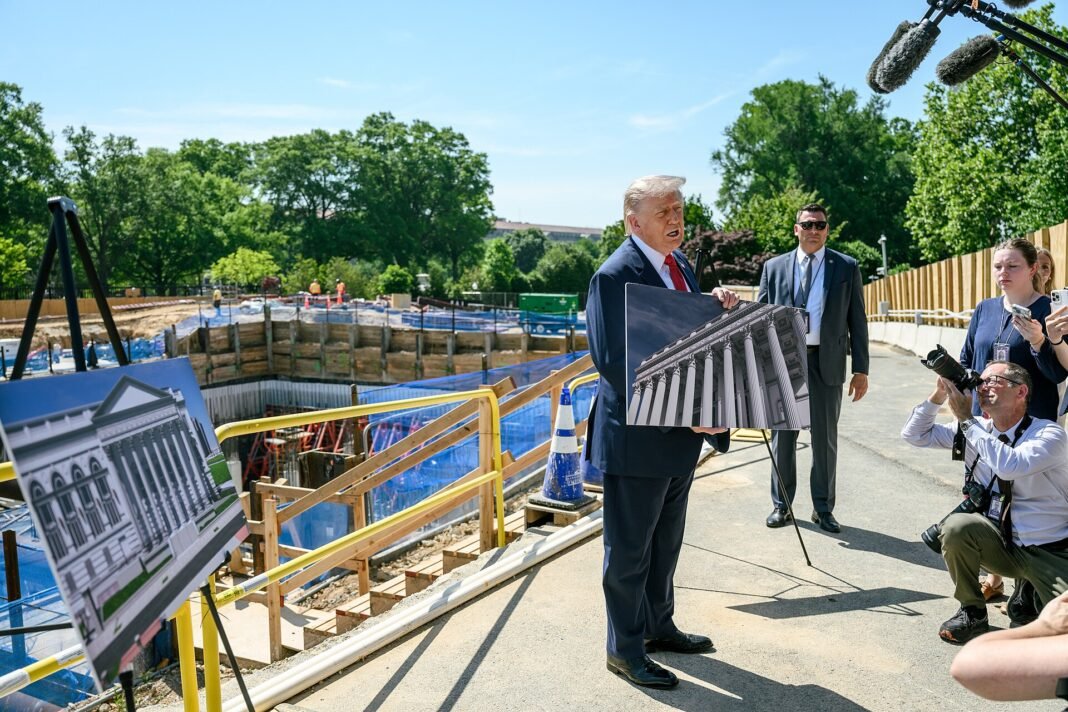
The U.S. Supreme Court on Monday halted a lower‑court injunction that had stopped construction of President Trump’s new White House ballroom. The 5‑4 ruling keeps the project alive while the legal battle continues.
Supreme Court Stays Injunction on Trump Ballroom
In a per curiam opinion, the Court granted the Trump administration’s request to stay an injunction issued by D.C. District Court Senior Judge Richard Leon. Leon had blocked above‑ground construction of the privately funded ballroom, arguing that Congress never authorized the work.
A three‑judge D.C. Circuit panel rejected the injunction’s removal on a 2‑1 vote earlier this month, prompting the administration to appeal. The panel’s decision set the stage for the Supreme Court’s review.
The majority concluded the government is likely to succeed on a significant legal question and would suffer irreparable harm without a stay. It also said the balance of equities favors lifting the injunction.
The Court said the National Trust for Historic Preservation lacks standing to challenge the East Wing project. It noted that member Alison Hoagland’s claim that viewing the finished ballroom would injure her aesthetic, cultural and historical interests is merely a matter of taste. Such grievances do not meet Article III’s concrete‑and‑particularized injury requirement, the majority wrote.
The justices warned that allowing the Trust’s suit would undermine the standing doctrine that bars lawsuits based on mere offense or distaste. They emphasized that no precedent permits treating aesthetic objections as a legally cognizable injury.
The Court also found that Judge Leon exceeded his Article III authority by ordering a coordinate branch to halt a presidential project. It highlighted the national security concerns raised by administration officials about the ballroom’s design.
The decision stops short of ruling on the project’s legality but signals the government will likely prevail on standing and stay factors. If the Supreme Court denies a petition for certiorari or elects to hear the case, the stay will end.
Chief Justice Roberts, dissenting, argued the ballroom construction is likely unlawful because it requires congressional approval. He warned the ruling permits the Executive to sidestep the Legislature’s power of the purse and its authority over federal property in D.C.
The stay remains in effect pending the government’s petition for a writ of certiorari, if filed timely. It terminates either when the petition is denied or when the Court decides the case on the merits.
Shawn Fleetwood, a staff writer for The Federalist and a University of Mary Washington graduate, received the 2025 Dao Prize for Investigative Journalism. His reporting appears in outlets such as RealClearPolitics and RealClearHealth. Follow him on Twitter @ShawnFleetwood

