
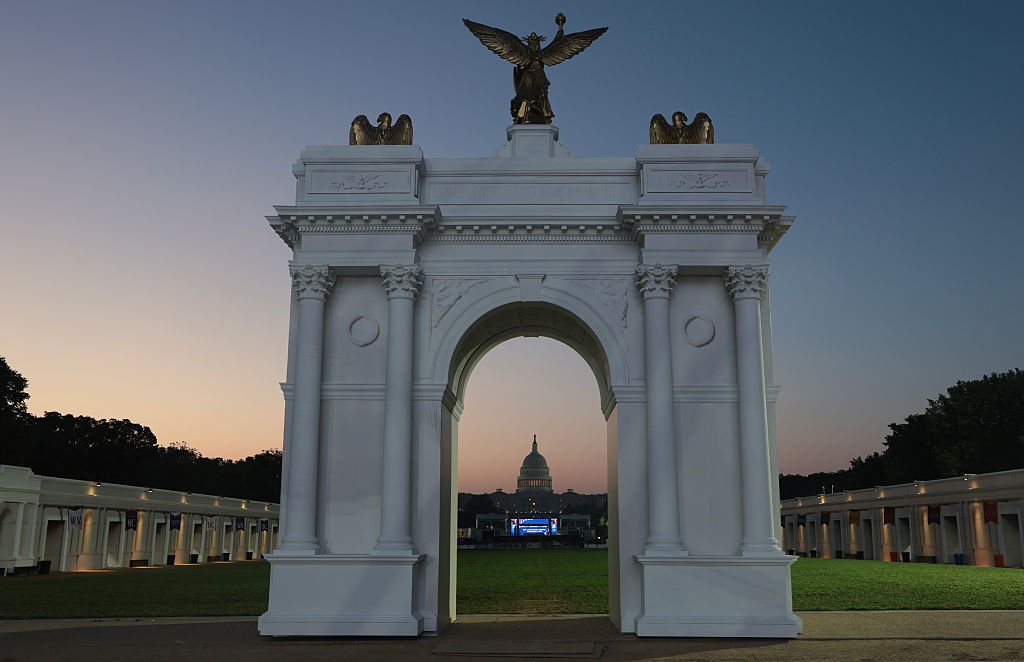
President Donald Trump’s plan for a 250‑foot Triumphal Arch in Washington, D.C., ignites a fierce clash over America’s architectural soul. The proposal, billed as a tribute to the nation’s 250th anniversary, would dominate a traffic circle with the mottos “One Nation Under God” and “Liberty and Justice for All.”
Arch Design and Intended Purpose
The 250‑foot structure would mirror the Arc de Triomphe in Paris, providing a space for veterans and potentially a military installation. Its neoclassical form draws on Roman arches that underpinned Western law and governance for a millennium.
Simply put, a war is on now for the soul of the nation.
Critics Decry Modernist Legacy
Opponents argue that the arch merely adds superficial pomp to a capital already scarred by 20th‑century brutalist projects. Architect Michael Curtis, author of “Classical Architecture and Monuments of Washington, D.C.,” labeled post‑war government buildings “Brutal Mistakes” that betray founding principles.
The 2020 Eisenhower Memorial shows uninspired statues dwarfed by a chaotic mesh tapestry. The 9/11 Pentagon Memorial’s illuminated benches resemble a skateboard park, while the 2011 Martin Luther King Jr. Memorial looks unfinished. The 1979 Einstein Memorial presents a crude sculpture.
Brutalist structures such as the Hubert H. Humphrey Building, the J. Edgar Hoover FBI headquarters, the Robert C. Weaver Federal Building, and the Forrestal Energy Department building, erected in the 1960s and 1970s, embody a countercultural rejection of traditional patriotism. Curtis argues these monolithic forms undermine the nation’s heritage.
Longfellow’s poem “The Builders” underscores the need for enduring beauty, a principle the Triumphal Arch embodies. The arch offers a physical and civic pathway for Americans to ascend toward the nation’s highest ideals.
If built, the monument would stand as a testament to classical excellence and a rallying point for national unity. Its critics, however, view it as an unnecessary flourish in a city already saturated with architectural controversy.

