
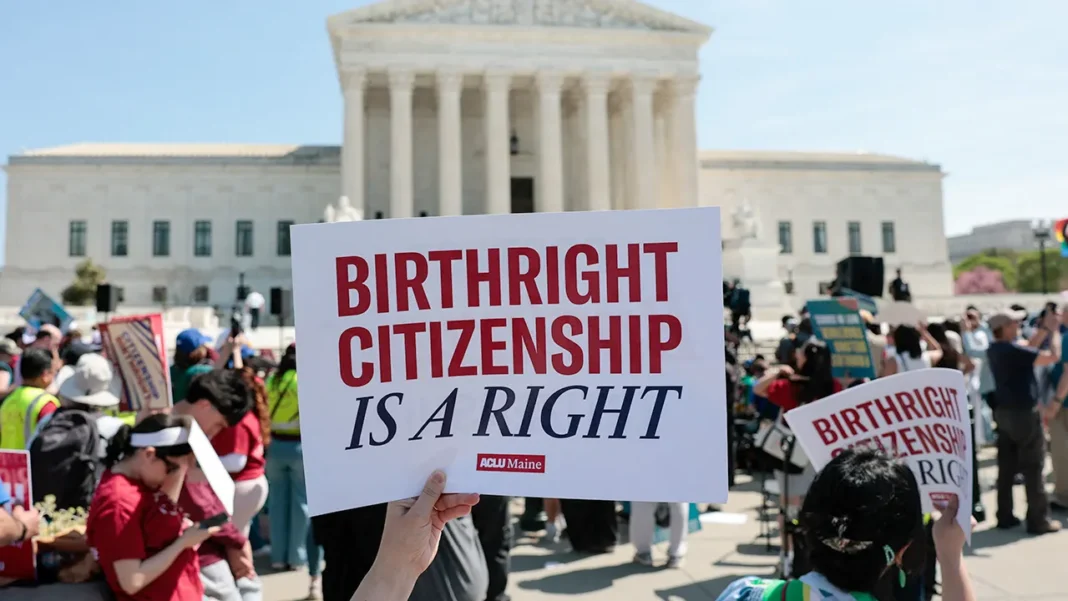
President Donald Trump signed two executive orders aimed at restricting birthright citizenship and curbing birth tourism, marking his latest push after the Supreme Court blocked his earlier attempt. Legal scholars say the new measures rely on longstanding exceptions to the 14th Amendment and could survive judicial scrutiny.
New Orders Expand Limits on Citizenship
The first order, signed Aug. 6, bars federal agencies from issuing documents that confirm citizenship for children born when neither parent is a U.S. citizen, including those whose parents belong to designated foreign terrorist groups or engage in fraud to obtain birthright status.
America First Policy Institute senior fellow Chad Mizelle, a former Justice Department chief of staff, argued the policy fits within historic exceptions for children of invading armies or enemy aliens recognized by the Supreme Court.
Legal Pushback and Standing Challenges
Manhattan Institute director Ilya Shapiro told Fox News Digital that the Supreme Court’s June ruling limits birthright citizenship only for children of diplomats or those born during hostile occupation, not for lawful residents, but the new order invokes the same enemy‑exception framework.
Cato Institute immigration director David Bier warned that the president cannot unilaterally redefine who counts as an “alien enemy” without congressional action, calling the move a “radical expansion” of executive power that would be unprecedented.
Legal analyst Amanda Frost noted that United States v. Wong Kim Ark (1898) bars citizenship for children of enemies “occupying” territory, meaning the order would not apply to terrorists residing in the United States, and could complicate criminal prosecutions if diplomats are broadened.
Birth Tourism Measures and Visa Denials
The second order tasks the State Department and Homeland Security with denying travel visas to individuals seeking to enter the United States solely to give birth, a practice known as birth tourism.
America First Legal co‑founder Gene Hamilton said this measure rests on “solid legal footing,” invoking Section 215(a) of the Immigration and Nationality Act to give the secretary of state authority over visa issuance.
Center for American Progress senior director Debu Gandhi countered that existing State Department rules already allow denial of visitor visas when the primary purpose is birth, making new executive orders unnecessary and constitutionally dubious.
Political and Legislative Outlook
If courts strike down the orders, supporters may pursue congressional legislation or a constitutional amendment to alter the 14th Amendment, a process requiring approval by three‑fourths of the states.
Shapiro added that the administration’s narrower approach could have avoided the earlier Supreme Court defeat, but the current orders remain on hold pending a Maryland injunction hearing scheduled for Aug. 28 and a New Hampshire motion.
The White House did not respond to a request for comment.

