
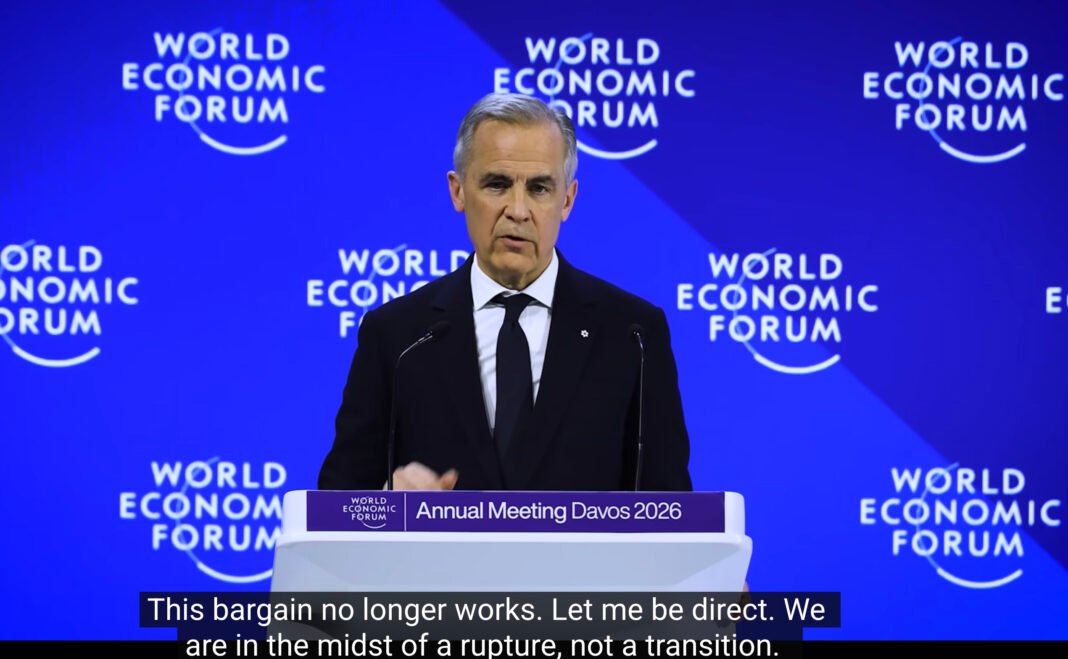
Canadian Prime Minister Mark Carney stunned the world by reversing his earlier anti‑U.S. rhetoric, urging deeper North American ties just months after denouncing the United States as a “degenerate and power‑mad” nation.
Contradictory Speeches
In a January speech at the World Economic Forum in Davos, Carney condemned America as an “old order” and promised to shift Canada’s strategic posture toward a coalition of middle powers, effectively embracing China.
He did not disclose that his plan would rely heavily on Chinese engagement.
Three months later, Carney traveled to New York and argued that the United States depends on Canadian oil, natural gas, electricity, aluminum, potash, nickel, copper and industrial components, urging greater bilateral trade.
“That is mutual strength. Canada Strong will help make America great again. The examples are legion where we should work together and compete with the world together,” he said.
Media Reaction
U.S. columnist David French of The New York Times hailed the earlier Davos remarks as “the most important address of Trump’s second term so far,” claiming it marked a path toward a new great‑power rival to the United States.
Politico echoed the narrative, describing Canada’s approach as a “muscular anti‑Trump strategy.”
Canadian scholar Stephen Nagy countered that Carney’s theory was “elegant but practically impossible,” noting the lack of concrete policy steps.
Analysis
Carney’s shift illustrates a rapid pivot: from a hardline stance that framed the United States as an adversary to a pragmatic appeal for integrated markets on critical minerals and supply chains.
He emphasized that Canada remains America’s largest trading partner and that a unified North American market offers the most durable response to global competition.
Political analysts warn that the reversal may reflect changing domestic pressures rather than a genuine ideological shift, but the facts remain: Carney first rejected U.S. dominance, then called for closer cooperation.
As one observer noted, “the world keeps turning, regardless of the speeches.”

