
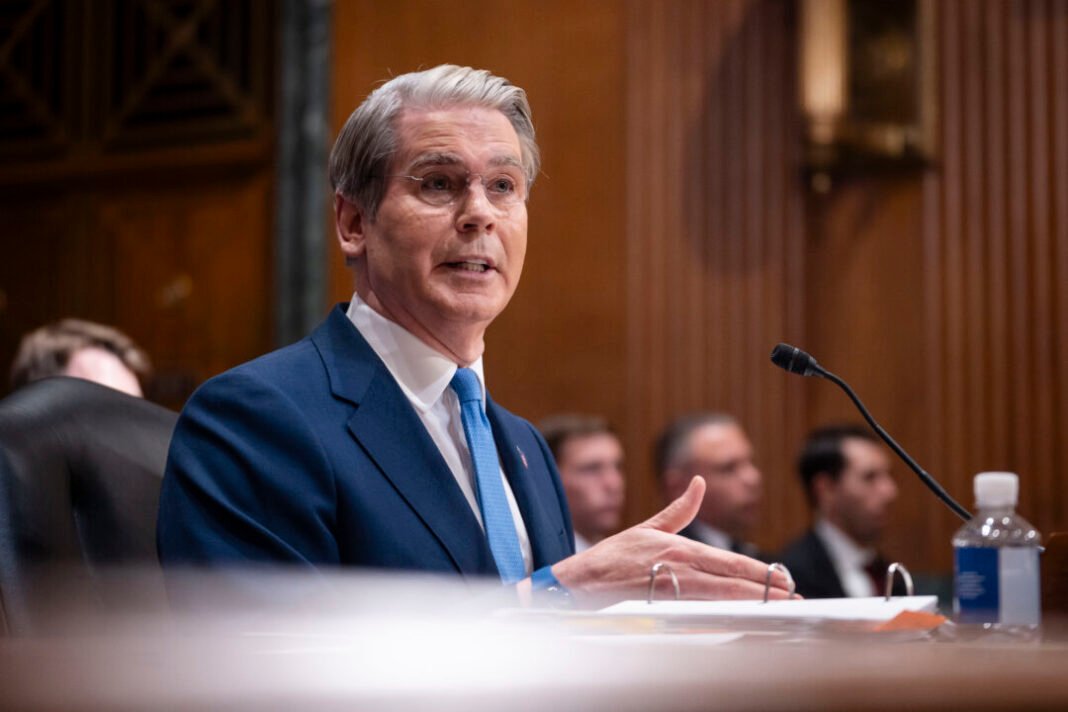
Treasury Secretary Scott Bessent warned on Aug. 23 that an “economic D‑Day” is coming for Tehran, signaling the United States will sever Iran’s financial lifelines. He made the statement ahead of a press conference scheduled for Aug. 24.
Economic D‑Day Looms Against Iran
Bessent said in a social media post that under President Donald Trump the U.S. military has dismantled Iran’s armed forces and destroyed most of its factories, crippling its nuclear program. He said the campaign has left Tehran with limited capacity to project power.
The United States and Israel launched strikes against Iran in late February, prompting Tehran to attack regional bases hosting U.S. troops and to target maritime traffic in the Strait of Hormuz. The retaliation has heightened regional tensions and raised fears of a broader confrontation.
“We are now entering the endgame,” Bessent declared. “At dawn begins an economic D‑Day—the single greatest financial offensive ever marshaled against an adversary.”
He added that Trump has empowered the administration to use every agency, authority and tool to cut off Tehran’s finances until the regime is completely isolated. The strategy aims to pressure Tehran into compliance without resorting to kinetic force.
“The Islamic Republic has survived by turning extortion into security guarantees,” Bessent said. “Under President Trump, that era is over, and anyone who doubts the cost of defying Washington does so at their own peril.”
Bessent made the remarks ahead of a press conference on Aug. 24, where he is expected to announce new sanctions targeting Iran and its trading partners. The measures are expected to expand existing restrictions and introduce fresh penalties.
In an Aug. 23 Financial Times op‑ed, Bessent warned that nations purchasing Iranian oil would face consequences, though he offered no specifics. He argued that such engagement enables the regime’s survival.
Iran’s Supreme National Security Council secretary Mohsen Rezaee threatened on social media that economic isolation would force Tehran to block oil shipments through the Persian Gulf and the Strait of Hormuz, calling any support for U.S. actions an act of war. He said the move would strike at global energy markets.
President Masoud Pezeshkian defended a June memorandum with an unnamed partner, stating it offers the best path to end a conflict he described as “neither war nor peace.” He said the agreement does not amount to capitulation.
The memorandum called for the full reopening of the Strait of Hormuz and set a 60‑day window that expired Aug. 16 to resolve the war and Iran’s nuclear program. Negotiations have not succeeded in meeting the deadline.
Negotiations to restore maritime traffic have stalled; Iran insists it will continue restricting shipping until the United States lifts its naval blockade, withdraws troops, and ends sanctions. The deadlock underscores the lack of trust between the parties.
Trump told reporters on Aug. 21 that Iran is ready to negotiate but must accept terms acceptable to the United States, which he says includes preventing Tehran from acquiring a nuclear weapon. He warned that any deal lacking those conditions would be unacceptable.
The Associated Press contributed to this report.

